Unrelated to anything in this post, I have a new dress. (I'm the one that looks like Mrs. Frizzle on acid.)
So, my parents are in Dakar. It’s both delightful (I have missed them! They are staying in a swank hotel that looks like an Indiana Jones set!) and strange (They don’t speak French! Everyone thinks my dad is German for unknown reasons!).
Mostly, though, this trip has given me an insight into how little of downtown Dakar I have visited. This is not entirely due to my homebody ways–my program directors have managed to convince me that downtown is full of Riots, All The Time.
It turns out that that’s not true! (Knock on wood.) Mostly downtown Dakar is full of really good (if expensive) food and hilariously unsafe traffic. Also, there’s embassies. Like, twenty of them within a block of our hotel. I can’t tell if there was a meeting about it or if the tax rate in this part of town is great, but this place is internationally bouncing. Continue reading →
So apparently my family is reading this blog. Hi, family! Welcome. I’m sorry that this is vaguely incoherently copyedited pretty much always. (Please don’t tell my English professors.)
ANYWAY. Back to what I was thinking about, which was: cold showers. Specifically, the fact that I have been taking one a day for–just checked the calendar–25 days (there were hot showers during orientation)–and I have still in no way grown accustomed to them.
At the beginning, cold showers seemed like a surmountable obstacle. Everyone else here does them, I figured, and so I should be able to too. It’s not like I’m hanging out taking leisurely, thinking-type showers. I’m basically doing a slightly glorified version of hair-face-pits-crotch-feet and bouncing. My mid-back has not seen water in literally two weeks, and I can’t tell if what’s going on back there is dirt or sunburnt skin that won’t peel or what, because it does not contribute to my overall odor factor. Continue reading →
I could lie and say that I’ve quit updating as regularly because I’ve been off exploring Dakar, but that would be a complete lie. Mostly, my computer got knocked off a desk and its screen imploded, so that’s been putting a cramp in my style. Rather than using the extra time to learn Wolof/figure out how to barter at all successfully, I’ve been taking naps, reading, and talking to my host dad. It turns out that Dakar is a lot like the year that I moved to Atlanta, in terms of my active social life and propensity to take risks.
As an aside, yesterday my host dad told me that I need more friends. I may need to reevaluate some life choices here.
Life is not all incredibly boring, though! Last week, I went to the HLM market, the local source for all things fabricy, with a friend. (See, host dad!) I took the wax cloth that I bought to the tailor in order to have it whipped into garmenty shape, and I picked the dress up yesterday. The whole setup cost $17 (fabric plus labor), and fits wonderfully. Plus: fabric covered buttons and pockets. I think the tailor may have replaced the guy who works at the sandwich shop behind school as my favorite person I’ve interacted with this week. Continue reading →
A few nights ago, my sister and I attended the Atlanta portion of the 2012 Tour de Nerdfighting. For those not in the know, this was a promotional event put on by John Green as part of his promotional tour for The Fault in Our Stars. In addition to the book reading and after-speech signing that is sort of standard at these events, this particular presentation included sock puppets, Hank Green (John’s brother) singing a song about quarks, and an 876-person audience getting rickrolled by two guys from the internet.
John Green talked to my sister about the Mountain Goats, though she thought he was talking to her about mountain goats.
It was pretty cool.
I enjoyed The Fault in Our Stars, which is a well-done book that manages to combine very sad things with very funny things in a way that is neither callous nor overly-emotional. It’s about two kids, ages 16 and 17, falling in love for the first time after meeting in a support group held in the Literal Heart of Jesus. Both of them have cancer. They’re also really funny, in a way that only literary teens can be. They’re also empathetic and selfish and worried about their parents in the way that actual teens are. You should read the book, if you haven’t.
Though I found some of my fellow book event attendees a trifle overenthusiastic (which, given that they’re in the intended age range for young adult fiction and I am not probably just means that I am crotchety and old now), everyone there seemed like good people. I don’t think I was that friendly and open and enthusiastically weird at 15, and so it’s cool to see people who are. Young adult book events are like incredibly friendly concerts. They’re their own little fandom community come to meat space.
I find the Green brothers interesting on a professional level, as they have managed to both create successful careers with multiple income streams facilitated by the internet. But on a more personal level, they seem like good people. I like that good people exist in any space, and I am even happier that they can sell out an auditorium so that it is full of enthusiastic, weird, friendly people who like what they’re saying. It’s a good sign.
So, today I got a note from Bank of America telling me that—as a result of some suspicious charges—my debit card had been suspended. I had to call them to get the card reinstated.
I assumed that something in my last week’s worth of purchases (all sort of odds and ends to prepare for my trip to Senegal this week) had tripped the algorithm. My money was on the three transactions that I managed to have take place at REI last week, despite having never spent money on fitness gear before.
Once I worked my way through the many painful phone menus involved in getting to the right customer service robot, the system read the suspicious charges to me. The REI charges were not among them. In fact, none of my unusual travel charges were. Instead, my card got flagged for these three purchases:
$8.56 spent on pizza at 10:30 last night.
$8.93 spent on grocery store mini cheesecakes at 10:00 the night before.
$25.00 spent at a CVS the night before that. (Which was very nearly $45.00, but they were out of Genie Bras in my size.)
Bank of America flagged me for buying food—and in the CVS case, acne medication—late at night. Along with being massively embarrassing (mini cheesecakes are not a food that screams “dignity”), these purchases are completely within the realm of normal for me. I have been to all of these stores before. I usually spend about $10 when I get food and about $25 when I go on a CVS binge.
What I have not ever done is spend $100 at REI, then get refunded $50, then spend $26, then get refunded $26. That transaction (having to do with some confusion about what mosquito net I needed) happened the same day as the CVS debacle, and BoA did not bat an eye at it.
The algorithm it’s applying to my account is one that makes sense for my parents. It is not one that makes sense for a physically inactive college student with poor impulse control and a deep love of cream cheese. Conveniently, as Bank of America has every possible bit of information about me, it knows which one of those two demographics I fit in.
So, the moral of this story—for those of you seeking to commit identity fraud—is to buy some really sweet and easily resold luggage at REI. However, avoid groceries. The bank might catch on.
Recently, a friend of mine who just returned from a semester abroad in Capetown sent me a link to Gurl Goes to Africa. The site is basically a Failbook for peoples’ pictures from their study abroad experiences in various African countries. I’ve been trying to decide how I feel about the site.
On the one hand, some of the material showcased—the photos of white Americans quite literally riding on the backs of Africans—are cringeworthy. Folks should know better than to a) do that and b) photograph and post it without massive context provided.
A lot of the photos aren’t that offensive, but are of the “starving African child with white person” genre—they’re aid brochure photos. And I do think that the comments on the photos (many of which are along the lines of “I couldn’t tell which one was you! lol”) deserve to be critiqued.
However, I think the site conflates the two and assigns them equal degrees of offensiveness when they’re not there. Should we question why photos of children are the dominant narrative for peoples’ study abroad experiences in various parts of Africa? Of course.
But—and I say this as someone who will no doubt take photos of her host siblings—not all photos of children are racist holdovers. Some are just the acknowledgement of the existence of children in the location that one traveled to. Photos of random street children (or other peoples’ kids) are offensive, but photos of people you know who happen to be children aren’t, at least to me.
What becomes an issue is when that’s all you photograph. However, because of the Failbook setup of the blog, the photos are all from individual contributers. I have no idea if this is one photo of a person’s host brother, or one of eighty photos of the Poor African Children.
The other issue that bothers me a little bit is that the blog is aggressively mocking women. White American women make up the majority (like 90%) of the people made fun of in the posts. The blog’s name makes fun of women travelers specifically. There are some men featured, but if the blog’s intent is to make fun of the Africa as Country view (as well as the Africa as Location for Anti-Consumerist Fantasies of the Wealthy view) then men and women can be more equally lampooned. I find it uncomfortable that there is page after page after page just of women being somewhat cattily made fun of. It implies a view that men aren’t as silly as these Gurls are.
My suspicion is that the blog author just particularly dislikes photos of Americans and African children (legitimately problematic) but that as a result of women being more likely to interact with children when traveling, the photos are skewed.
The behavior and viewpoint that the blog is satirizing deserve to be made fun of. But the way in which it’s done makes me uncomfortable. Am I just being oversensitive?
Yesterday, I finished re-reading Franny and Zooey. This is the third or fourth time I’ve read the book, which I found early on in high school. I relate to it the way that a whole slew of folks relate to Catcher in the Rye, which Salinger is of course much better known for.
For those who haven’t raed the book, it follows Franny Glass, the 20-year-old youngest sibling of a large family of kids who spent much of their childhood performing on a radio quiz show called It’s a Wise Child. After reading a book taken from the room of her beloved eldest brother (who committed suicide several years before the book takes place), she attempts to pray without ceasing. Disillusioned by college, she has a nervous breakdown. The rest of the book consists of the next-oldest sibling, her 25-year-old brother Zooey, talking her out of her breakdown.
I always took more to Franny than to Holden Caulfield. I suspect that I would like him more if I reread Catcher in the Rye now, but when I first read it I was too close in age to him not to find him annoying. Franny was enough older than me that I liked her. True to form, now that I am the same age that she is, I see why Zooey is annoyed by her breakdown even as I have spent much of my time at Emory struggling with the same disillusionment.
In class this semester we talked about the structure of rites of passage. We focused on two models—one from van Gennep, and one from Lincoln. I think it’s interesting how the two Salinger books follow the two models.
Van Gennep‘s three-part structure for rites of passage (separation, liminality, incorporation) works incredibly well for many male initiation rituals. Professors love to use the example of fraternity hazing to illustrate the model, and to van Gennep’s credit it works very well. However, it doesn’t work for a lot of women’s rituals, which often depend on individual biological realities (like when a specific girl begins to menstruate) and focus on the girl’s relationship to her family, rather than her peers.
Lincoln‘s model attempts to find a more universal pattern from women’s rituals. In it, women’s rituals follow the model of seclusion, metamorphosis, and emergence. The woman’s ritual takes place alone or within her family home, rather than with the other girls of the village.
Neither model is universal, and there are plenty of cultures which violate the “correctly”-gendered model or conform to neither, but they are useful frameworks. It wasn’t until this year that I realized that Catcher in the Rye follows van Gennep’s pattern and Franny and Zooey follows Lincoln’s.
It was interesting to have my coursework so directly impact my interpretation of a book that I love. Buddy Glass, the narrator, asks whether the story is a mystical story or a love story, but it is of course also a story about a very American rite of passage. We talk a lot in my anthropology classes about how Americans lack rites of passage, and I think that Salinger shows two very American rites of passage in these books.
It’s something of a joke among those who live in close quarters with me that I tend to dress in uniforms. This probably comes from the same part of me that can spend a month watching 6 seasons of a foreign TV show, twice, without tiring of it basically being the same show each week. I am comfortable with routine.
The most recent iteration of the uniform was a blazer, a scoop neck t-shirt, jeggings, red shoes, and a large scarf. Because all my shoes are red and all of my t-shirts are the same thing in different colors, this allowed for a variety of outfits with pretty much no effort. Plus, I always had a built-in blanket for cold classrooms. It was a win win.
Recently, however, I’ve moved away from the blazer-scarf-jeggings power look. I got tired of having a sweaty neck all of the time.
Without meaning to, I have settled in to a new uniform. For the past three days (I really wish I was exaggerating for effect, here) I have worn one of my two pairs of skinny jeans, one of the same scoop neck tees, and a tweed jacket that looks like a stole it off a very narrow-shouldered male archaeologist. The jacket is reversible, so if I tire of the tweed* I can revisit my elementary school uniform and wear some khaki instead.
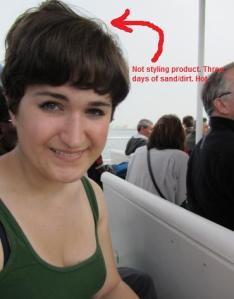
The uniform, combined with my short hair and a non-expression that I am told makes me look very angry, tends to make me look sort of like a teenaged boy. I think that part of it is me making myself as unnoticeable as possible using the things over which I have control over for when I go to Dakar. I can’t control being white and American, but I can confine myself to earth tones with the best of them.
But I think even without the trip abroad, I’d be moving in that same direction. There was a period in high school where my wardrobe was hyperfeminine, as was my hair—there were a lot of sundresses and pincurls and pencil skirts. Without me noticing, my wardrobe has shifted from red into blue into grey and brown over the last semester.
I spent so much of this year being anxious whenever I spoke in class and hoping that I would be sort of ignored. Of course, I still raised my hand in class and pretty much never shut up**, but I felt bad when I did. It was a really weird combination of feelings and impulses, and I think that the move into more muted colors and more androgynous cuts of clothing had something to do with it.
But, even as my clothes become less colorful, I am struck by how I feel when I’m wearing them. When I’m channeling Agyness Deyn with some combat boots and the punker jacket, I feel powerful in a way that sundresses and heels didn’t necessarily make me feel. It’s superficial, but there’s something to be said for the knowledge that you could kick some ass in your clothing.
The weather now is similar to what the weather will be when I go abroad. All signs point to me keeping more or less this uniform while I’m there. I’m interested to see whether my feelings about power and clothing stay the same while I’m traveling. I suspect that they will not.
This got to be much more serious than I intended. Because what I originally wanted to share about the jacket that makes up the main part of the new uniform is that it’s reversible, it’s tweed, and it cost me $6.95.
I am the queen of thrift stores.
* I will not tire of the tweed.
** I thirst for external approval like a vampire for blood. Blame magnet school.
Since moving off oral contraceptives*, my face has exploded in oil. I wear foundation and pressed powder on a day-to-day basis, and within ten minutes everything I’m wearing is an oil slick in the middle of my face. I look like I am perspiring from my nose.
Add this to the fact that my skin is pale and shows discolorations easily, and you get shiny skin with very red, very noticeable blemishes. This is only exacerbated when I pick at them, which is a disgusting, unhelpful habit that I nonetheless find soothing**.
The end result of this is that I really, really hate my skin. And it makes me feel like a terrible feminist.
I know, realistically, that oily skin is not the end of the world and is not any reflection on my personal hygiene habits or on me. I know that actual human beings have actual human pores and the fact that I do too should not bother me the way that it does. I know that most of my friends are women, which I do not date, and so the fact that my skin is in various states of hot mess does not change the way that most folks around me are going to think about me. (I hope.) I know that my skin has nothing to do with my ability to be interesting, or funny, or intelligent.
As much as I know all of these things (and I do!), I hate my skin with a visceral sort of disgust if I think about it too much.
I want to be the sort of person who can go all Amanda Palmer and just tell the beauty standard to go fuck itself while I let my pit hair grow and shave of my eyebrows. But I’m very clearly not. This leaves me with a sense that I have failed twice: once, by having bad skin, and twice, by being bothered by it.
This is not a healthy way to relate to my face.
I am curious whether going abroad will change my attitude about my skin. Not in a mystic-journey-to-a-place-where-people-are-so-above-that kind of way, but in a will-be-walking-lots-and-eating-better-and-not-spending-so-much-time-in-the-mirror kind of way. Until then, I am holding off on any feminist epiphanies. Because, truth be told? I still really hate my skin.
A little while ago, I went to go see The Room with a group of friends. In addition to being a delightful reminder that chunks of Atlanta are very similar to a small town (Oh hi there, 20 kids I went to high school with! Hello, friends of my friend’s roommate!), the film was its usual dose of terribad. (For those who have not seen it, The Room is regarded as possibly the worst film ever made. Seeing it in public involves pelting the screen with spoons. It’s like a mellower Rocky Horror Picture Show.)
For the most part, the shoutalong dialogue was great. The film truly is terrible, and public evisceration of continuity errors, unlit establishing shots, and inexplicably graphic (and occasionally out of focus) sex scenes is great fun.
But there was a second undercurrent to the shoutalong commentary that was frustrating and a little disheartening. Though the main female character is a badly-written, sociopathic robot of a human being, most of the insults directed at her were comments about how she was a) a whore, or b) fat. It’s irritating to have a mostly-male set of commentators commenting on the woman’s weight and perceived unsexyness when she’s thinner than you and—if she was just a person you met on the street—pretty conventionally cute.
Poking fun at the cheesy sex scene music and the needless nipples is great, and is pretty equal opportunity. But shoutalong commentary seems to be prone to devolving into sexist jeering at actresses for not being the right kind of hot. That’s unfair, and displays the same troubling assumptions about the fact that it’s a woman’s duty to be attractive that routinely get critiqued in the feminist internet corner.
Everyone at my post-movie diner table agreed that the looks-based insult commentary had made them uncomfortable to varying degrees. This included some folks who had participated in it. If we’re a representative group, then it seems like folks viewing the film should make an effort to move away from the “Ew, she’s fat” commentary and back into the “You’re reusing sex scene footage and for the love of Christ why are you people petting each other with roses” school.
The Room is great and terrible on its own. Sexism doesn’t make it better, funnier, or more enjoyable to fling spoons at. The film is misogynist in its own right. Making fun of that is much more entertaining than contributing to it, and it has the bonus fun time side effect of not making half the theater kind of uncomfortable.


 Dances With Nerds