Friday Night, Time to Knap

Yesterday, my friend Avery and I went flint knapping outside of the anthro building. For those who aren’t anthro majors/hill people, flint (or stone) knapping is the process of taking a large chunk of rock and turning it into a smaller, hopefully tool-like chunk of rock. Hobbyists use it to make arrowheads, which they exchange at “knap ins,” which are a thing that I am not even making up. The video above shows some of the gear required and the general strangeness of the process–if you see a giant chunk of bone on the table when he’s talking, that’s because it’s a moose bone that he makes stone tools with.

The professor above–who was a remarkably good sport about two undergrads showing up and demanding teaching, essentially–was helping us yesterday. He studies stone knapping techniques in the paleolithic era. Human stone tools from digs show an increase in complexity the nearer the dig gets to the present day, from this, to this, to this. The professor’s research (and the reason he was sitting around flint knapping on a Friday to begin with) is on what stone tools show us about the cognative abilities of the people who made them. He does this by scanning folks’ brains as they make stone tools.

It turns out that novices and skilled tool-makers light up different areas of their brains, and that the simpler tool styles (the monofacial ones, which can cut but are not great for chopping) light up older parts of the brain than more complicated tools. The question is whether advances in tool complexity represent the evolution of that more recent brain matter–they couldn’t make the tools until they had the ability to learn, visualize appropriately, and figure out some pretty complicated practical physics.

So Avery and I tried to make something. We tried to teach ourselves to stone knap last year, after seeing a video of Bruce Bradley. The thing that professors don’t tell you as much is that he’s pretty much the best flint knapper in this country, and despite how easy he makes it look it’s really hard. When we tried on our own, we were working with low-quality rock and no clue what we were doing, and wound up using the same technique to make blades as chimps have been shown to: we threw them at the ground until they shattered into smaller pieces. Yesterday, we fared a little better. Here’s what Avery made:

Though it doesn’t look like much, the scraper came from a much larger piece of flint, and is much better than what we got the first time. We’ll be going back next week, so hopefully I can try my hand at sucking a little less at banging rocks together.
Sexual Assault Awareness Month: Programming Style!

I just finished up the last of my two programs for Sexual Assault Awareness Month–this one on men and gendered violence. It was exciting, as these things go, because we had a guest speaker and people I didn’t tell to show up also came. Educational programming will cause you to lower your standards real quick-like.

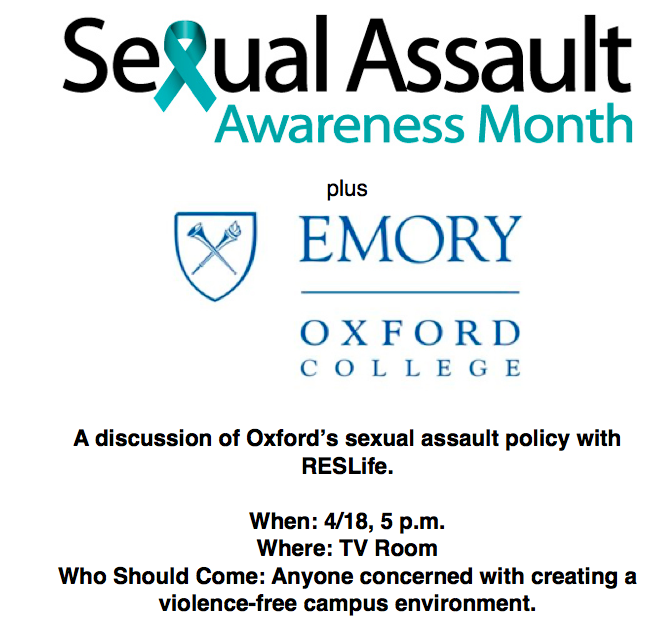
The first program involved our director of RES Life and focused on the Oxford College implementation of the Emory University assault policy. It was mostly attended by women, which was expected but always a little frustrating–women are most likely to be pressing charges under conduct, but men need to know what the policy covers in case their conduct is questionable or in case they are assaulted.

That being said, I was glad people came, and I do think it focused on something that more schools our size need to focus on–making sure students know the details of the policy and the process for going forward under school conduct board should the survivor choose to do so. Of course, as the speaker (my boss’s boss, for full disclosure) is a school employee who runs the process, she was more cheerful than I think the situation at our school deserves; sometimes it felt like valid student concerns (like the lack of minimum sentences for conduct violations, or concerns about the massive underreporting at Oxford) were being ignored, but small, significant changes are being made and that is at least something better than what we started with. Continue reading

What I Found Today (2/9/11)

How Sarah Palin Tortures the Bible: A takedown of Palin’s use of scripture, using more scripture in that magic little thing called “context,” written by Chris Lehmann, the Awl’s religion columnist. The link was found via Ana Marie Cox‘s Twitter feed. She’s also a journalist, and founded The Wonkette, my favorite political site for its focus on politics through a lens of “gin and anal sex.”

Culture in the US vs. Europe: Found via Zadi Diaz’s Twitter stream. A discussion among several women (and the male moderator) about what it means to live in a country where culture is judged by its success at being exported. Also brought up is an interesting discussion about what it means to contain a multitude of cultures–to be Hispanic, East-cost-to-West-coast, southern, in addition to being American. I really liked the discussion of what it means to have a global Internet culture–on some level, what matters is that you’re from the web. Zadi hosts the truly excellent EpicFu video podcast, which is targeted towards teens/young adults and is sort of Rocketboom for teh youths.

Red Panda Video: It’s a group of red pandas, trying to undo a door knob. My ovaries grew three sizes, y’all.

A Vest Pocket Guide to Brothels in 19th-Century New York for a Gentleman on the Go: Found in some archive somewhere, and stuck up by the NYT. It is truly funny, and the commentary by the person who assembled it is just excellent. Worth a read next time one of your professors decides to claim that we are culturally dead because of our obsession with sex/worthless internet media (not that this has ever happened in my classes, golly).

Woodruff Library Undergraduate Research Competition: A totally cool example of what libraries can do well! Undergrads at Emory College can receive $500 for submitting the winning research paper/project. Unfortunately, it does not appear to be open to Oxford College students, which makes me sad because we have no similar contest and our library, though it is staffed by some excellent people, is tiny. All of my sources for my projects come from Woodruff…

Emory Medical, Je T’Aime

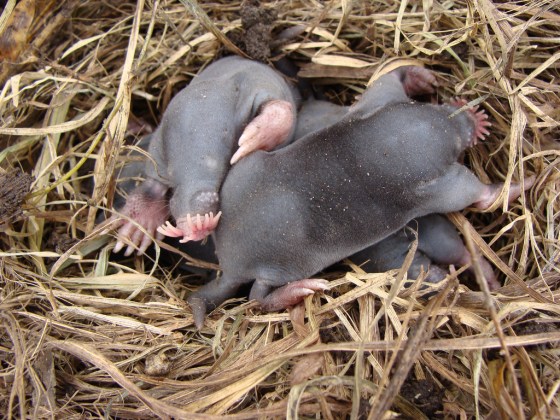
Baby moles in a nest.

These are much cuter than mine. Image courtesy of Flickr user Hillbraith.

Yesterday, I went to the dermatologist. I am, to use the scientific term, “moley,” so I go every year or so to have all my moles checked out and, if I’m lucky, numbed and lopped off. It’s very exciting, and has taught me just how much Novocaine stings when injected into not-your-jaw.

So, yesterday the PA is examining me, and we’re at the rather embarrassing part of the exam where this woman is looking at my ass for moles while asking me what major I am, and she started prodding one. She thought about it, measured it, examined it with something that appeared to be a cousin of those clip-on booklight magnifying glasses that old people buy, and stopped. “Well,” she said, “Either it’s grown bigger–which is bad–or it’s, er…. stretched.”

The woman was very diplomatically trying to tell me that I either had cancer or that my ass had gotten large. (I’m pretty sure it’s the latter. Thanks, Lil’s!) She then went on to proscribe me something for acne which I hadn’t actually asked for, which was entertaining. However, body image issues aside, it does seem that I’m cancer-free, so that’s nice.

This is the same PA who, when I first started visiting her at 13, told me I would probably be fine because the moles on my back were “covered with a fine, downy layer of hair.” Which is exactly what every body-conscious middle school girl needs to hear.

After the dermatologist, I went to the dentist. There, the dental hygienist made me watch my gums bleed heavily after she poked them will a metal toothpick in an attempt to, presumably, build character and/or scar me for the next six months.

It’s possible I need to find different doctors.

Make Life Easier: Ask a Librarian

Librarians: they're like superheroes in that they save you during finals and have secret lairs. Image courtesy of Flickr user Monika Bargmann. Licensed under CC 2.0 BY-NC-ND.

The school library (or, if you’re at a big school, libraries) are part of almost every college tour. Of course, in the age of digital information, the actual books contained in the library are no longer students’ most important resource at the library–instead, the librarians are.

Though often overlooked and under appreciated, librarians can make a student’s life much easier if they’re asked. Though your school may not have a program as intensive as Drexel’s personal librarian program, where freshmen get their own librarian to show them the research ropes, even the most unassuming librarian has training to help you find out what you need to know. If you’re looking for places to start, try these suggestions:

Instant Message a Librarian – Many universities have their librarians set up on Meebo, a site-nested instant messaging client that became unexpectedly very popular with the librarian community. If your university has a Meebo setup, you can anonymously ask librarians a silly or embarrassing question (where is the science building?), renew a book without going to the library, or ask them to help you when a professor has screwed up putting a book you need on reserve. A smaller number of schools even have a “text a librarian” feature for when you’re away from a browser. If your school doesn’t have either of these services set up, the Alexandrian Public Library, Texas State University Library, and Emory University Library all offer chat widgets that you can use for non-school-specific questions.

Read the rest at HackCollege.